Hi Again!
Here's some-a-thin more 'bout animals:
Animals
From Wikipedia, the free encyclopedia
Animals are a major group of mostly multicellular,
eukaryotic organisms of the
kingdom Animalia or
Metazoa. Their
body plan eventually becomes fixed as they develop, although some undergo a process of
metamorphosis later on in their life. Most animals are
motile, meaning they can move spontaneously and independently. All animals are also
heterotrophs, meaning they must ingest other organisms for
sustenance.
Most known animal
phyla appeared in the fossil record as marine species during the
Cambrian explosion, about 542 million years ago.
Etymology
The word "animal" comes from the
Latin word
animalis (meaning
with soul, from
anima, soul). In everyday colloquial usage, the word usually refers to non-
human animals.
[1] Frequently, only closer relatives of humans such as
mammals and other
vertebrates are meant in colloquial use.
[2] The biological definition of the word refers to all members of the kingdom Animalia, encompassing creatures as diverse as sponges, jellyfish, insects and humans.
[3]
Characteristics
Animals have several characteristics that set them apart from other living things. Animals are
eukaryotic and mostly
multicellular,
[4] which separates them from
bacteria and most
protists. They are
heterotrophic,
[5] generally digesting food in an internal chamber, which separates them from
plants and
algae.
[6] They are also distinguished from plants, algae, and
fungi by lacking rigid
cell walls.
[7] All animals are
motile,
[8] if only at certain life stages. In most animals,
embryos pass through a
blastula stage, which is a characteristic exclusive to animals.
Structure
With a few exceptions, most notably the
sponges (Phylum
Porifera) and
Placozoa, animals have
bodies differentiated into separate
tissues. These include
muscles, which are able to contract and control locomotion, and
nerve tissues, which send and process signals. Typically, there is also an internal
digestive chamber, with one or two openings. Animals with this sort of organization are called metazoans, or
eumetazoans when the former is used for animals in general.
All animals have
eukaryotic cells, surrounded by a characteristic
extracellular matrix composed of
collagen and elastic
glycoproteins. This may be calcified to form structures like
shells,
bones, and
spicules. During development, it forms a relatively flexible framework upon which cells can move about and be reorganized, making complex structures possible. In contrast, other
multicellular organisms like plants and fungi have cells held in place by cell walls, and so develop by progressive growth. Also, unique to animal cells are the following intercellular junctions:
tight junctions,
gap junctions, and
desmosomes.
Reproduction and development
Nearly all animals undergo some form of
sexual reproduction. They have a few specialized
reproductive cells, which undergo
meiosis to produce smaller, motile
spermatozoa or larger, non-motile
ova. These fuse to form
zygotes, which develop into new individuals.
Many animals are also capable of
asexual reproduction. This may take place through
parthenogenesis, where fertile eggs are produced without mating, or in some cases through
fragmentation.
A
zygote initially develops into a hollow sphere, called a
blastula, which undergoes rearrangement and differentiation. In sponges, blastula larvae swim to a new location and develop into a new sponge. In most other groups, the blastula undergoes more complicated rearrangement. It first
invaginates to form a
gastrula with a digestive chamber, and two separate
germ layers — an external
ectoderm and an internal
endoderm. In most cases, a
mesoderm also develops between them. These germ layers then differentiate to form tissues and organs.
Food and energy sourcing
All animals are
heterotrophs, meaning that they feed directly or indirectly on other living things. They are often further subdivided into groups such as
carnivores,
herbivores,
omnivores, and
parasites.
Predation is a
biological interaction where a predator (a heterotroph that is hunting) feeds on its prey (the organism that is attacked). Predators may or may not kill their prey prior to feeding on them, but the act of predation always results in the death of the prey. The other main category of consumption is
detritivory, the consumption of dead
organic matter. It can at times be difficult to separate the two
feeding behaviours, for example, where
parasitic species prey on a host organism and then lay their eggs on it for their offspring to feed on its decaying corpse. Selective pressures imposed on one another has led to an
evolutionary arms race between prey and predator, resulting in various
antipredator adaptations.
Most animals feed indirectly from the energy of
sunlight. Plants use this
energy to convert sunlight into simple
sugars using a process known as
photosynthesis. Starting with the molecules
carbon dioxide (CO
2) and
water (H
2O), photosynthesis converts the energy of sunlight into chemical energy stored in the bonds of
glucose (C
6H
12O
6) and releases
oxygen (O
2). These sugars are then used as the building blocks which allow the plant to grow.
[9] When animals eat these plants (or eat other animals which have eaten plants), the sugars produced by the plant are used by the animal. They are either used directly to help the animal grow, or broken down, releasing stored solar energy, and giving the animal the energy required for motion. This process is known as
glycolysis.
Animals living close to
hydrothermal vents and
cold seeps on the
ocean floor are not dependent on the energy of sunlight. Instead
chemosynthetic archaea and
bacteria form the base of the
food chain.
Origin and fossil record
Animals are generally considered to have
evolved from a
flagellated eukaryote. Their closest known living relatives are the
choanoflagellates, collared flagellates that have a morphology similar to the choanocytes of certain sponges.
Molecular studies place animals in a supergroup called the
opisthokonts, which also include the choanoflagellates,
fungi and a few small parasitic
protists. The name comes from the posterior location of the
flagellum in motile cells, such as most animal spermatozoa, whereas other
eukaryotes tend to have anterior flagella.
The first fossils that might represent animals appear in the Trezona Formation at Trezona Bore, West Central Flinders, South Australia.
[11] These fossils are interpreted as being early sponges. They were found in 665-million-year-old rock.
[11]
The next oldest possible animal fossils are found towards the end of the
Precambrian, around 610 million years ago, and are known as the
Ediacaran or Vendian biota. These are difficult to relate to later fossils, however. Some may represent precursors of modern phyla, but they may be separate groups, and it is possible they are not really animals at all.
Aside from them, most known animal phyla make a more or less simultaneous appearance during the
Cambrian period, about 542 million years ago. It is still disputed whether this event, called the
Cambrian explosion, represents a rapid divergence between different groups or a change in conditions that made fossilization possible.
Some paleontologists suggest that animals appeared much earlier than the Cambrian explosion, possibly as early as 1 billion years ago.
Trace fossils such as tracks and burrows found in the
Tonian era indicate the presence of
triploblastic worms, like metazoans, roughly as large (about 5 mm wide) and complex as
earthworms.
[12] During the beginning of the Tonian period around 1 billion years ago, there was a decrease in
Stromatolite diversity, which may indicate the appearance of grazing animals, since Stromatolites diversity increased when grazing animals went extinct at the
End Permian and
End Ordovician extinction events, and decreased shortly after the grazer populations recovered. However the discovery that tracks very similar to these early trace fossils are produced today by the giant single-celled protist
Gromia sphaerica casts doubt on their interpretation as evidence of early animal evolution.
[13][14]
Groups of animals

The relative number of species contributed to the total by each phylum of animals.
Porifera, Radiata and basal Bilateria

Orange elephant ear sponge,
Agelas clathrodes, in foreground. Two corals in the background: a
sea fan,
Iciligorgia schrammi, and a sea rod,
Plexaurella nutans.
The sponges (
Porifera) were long thought to have diverged from other animals early. They lack the complex organization found in most other phyla. Their cells are differentiated, but in most cases not organized into distinct tissues. Sponges typically feed by drawing in water through pores.
Archaeocyatha, which have fused skeletons, may represent sponges or a separate phylum. However, a phylogenomic study in 2008 of 150 genes in 21 genera
[15] revealed that it is the
Ctenophora or comb jellies which are the basal lineage of animals, at least among those 21 genera. The authors speculate that sponges—or at least those lines of sponges they investigated—are not so primitive, but may instead be secondarily simplified.
Among the other phyla, the Ctenophora and the
Cnidaria, which includes
sea anemones,
corals, and
jellyfish, are radially symmetric and have digestive chambers with a single opening, which serves as both the mouth and the anus. Both have distinct tissues, but they are not organized into
organs. There are only two main germ layers, the ectoderm and endoderm, with only scattered cells between them. As such, these animals are sometimes called
diploblastic. The tiny
placozoans are similar, but they do not have a permanent digestive chamber.
The remaining animals form a
monophyletic group called the
Bilateria. For the most part, they are
bilaterally symmetric, and often have a specialized head with feeding and sensory organs. The body is
triploblastic, i.e. all three germ layers are well-developed, and tissues form distinct organs. The digestive chamber has two openings, a mouth and an anus, and there is also an internal body cavity called a
coelom or pseudocoelom. There are exceptions to each of these characteristics, however — for instance adult
echinoderms are radially symmetric, and certain
parasitic worms have extremely simplified body structures.
Genetic studies have considerably changed our understanding of the relationships within the Bilateria. Most appear to belong to two major lineages: the
deuterostomes and the
protostomes, the latter of which includes the
Ecdysozoa,
Platyzoa, and
Lophotrochozoa. In addition, there are a few small groups of bilaterians with relatively similar structure that appear to have diverged before these major groups. These include the
Acoelomorpha,
Rhombozoa, and
Orthonectida. The
Myxozoa, single-celled parasites that were originally considered Protozoa, are now believed to have developed from the Medusozoa as well.
Deuterostomes
Deuterostomes differ from the other Bilateria, called
protostomes, in several ways. In both cases there is a complete digestive tract. However, in protostomes, the initial opening (the
archenteron) develops into the mouth, and an anus forms separately. In deuterostomes this is reversed. In most protostomes, cells simply fill in the interior of the gastrula to form the mesoderm, called schizocoelous development, but in deuterostomes, it forms through
invagination of the endoderm, called enterocoelic pouching. Deuterostomes also have a dorsal, rather than a ventral, nerve chord and their embryos undergo different cleavage.
All this suggests the deuterostomes and protostomes are separate, monophyletic lineages. The main phyla of deuterostomes are the
Echinodermata and
Chordata. The former are radially symmetric and exclusively marine, such as
starfish,
sea urchins, and
sea cucumbers. The latter are dominated by the
vertebrates, animals with backbones. These include
fish,
amphibians,
reptiles,
birds, and
mammals.
In addition to these, the deuterostomes also include the
Hemichordata, or acorn worms. Although they are not especially prominent today, the important fossil
graptolites may belong to this group.
The
Chaetognatha or arrow worms may also be deuterostomes, but more recent studies suggest protostome affinities.
Ecdysozoa
The
Ecdysozoa are protostomes, named after the common trait of growth by moulting or
ecdysis. The largest animal phylum belongs here, the
Arthropoda, including
insects,
spiders,
crabs, and their kin. All these organisms have a body divided into repeating segments, typically with paired appendages. Two smaller phyla, the
Onychophora and
Tardigrada, are close relatives of the arthropods and share these traits.
The ecdysozoans also include the
Nematoda or roundworms, perhaps the second largest animal phylum. Roundworms are typically microscopic, and occur in nearly every environment where there is water. A number are important parasites. Smaller phyla related to them are the
Nematomorpha or horsehair worms, and the
Kinorhyncha,
Priapulida, and
Loricifera. These groups have a reduced coelom, called a pseudocoelom.
The remaining two groups of protostomes are sometimes grouped together as the
Spiralia, since in both embryos develop with
spiral cleavage.
Platyzoa
The
Platyzoa include the phylum
Platyhelminthes, the flatworms. These were originally considered some of the most primitive Bilateria, but it now appears they developed from more complex ancestors.
[16] A number of
parasites are included in this group, such as the
flukes and
tapeworms. Flatworms are
acoelomates, lacking a body cavity, as are their closest relatives, the microscopic
Gastrotricha.
[17]
The other platyzoan phyla are mostly microscopic and
pseudocoelomate. The most prominent are the
Rotifera or rotifers, which are common in aqueous environments. They also include the
Acanthocephala or spiny-headed worms, the
Gnathostomulida,
Micrognathozoa, and possibly the
Cycliophora.
[18] These groups share the presence of complex jaws, from which they are called the
Gnathifera.
Lophotrochozoa
The
Lophotrochozoa include two of the most successful animal phyla, the
Mollusca and
Annelida.
[19][20] The former, which is the second-largest animal phylum by number of described species, includes animals such as
snails,
clams, and
squids, and the latter comprises the segmented worms, such as
earthworms and
leeches. These two groups have long been considered close relatives because of the common presence of
trochophore larvae, but the annelids were considered closer to the arthropods because they are both segmented.
[21] Now, this is generally considered
convergent evolution, owing to many morphological and genetic differences between the two phyla.
[22]
The Lophotrochozoa also include the
Nemertea or ribbon worms, the
Sipuncula, and several phyla that have a fan of cilia around the mouth, called a
lophophore.
[23] These were traditionally grouped together as the lophophorates.
[24] but it now appears they are
paraphyletic,
[25] some closer to the Nemertea and some to the Mollusca and Annelida.
[26][27] They include the
Brachiopoda or lamp shells, which are prominent in the fossil record, the
Entoprocta, the
Phoronida, and possibly the
Bryozoa or moss animals.
[28]
Model organisms
Because of the great diversity found in animals, it is more economical for scientists to study a small number of chosen species so that connections can be drawn from their work and conclusions extrapolated about how animals function in general. Because they are easy to keep and breed, the fruit fly
Drosophila melanogaster and the nematode
Caenorhabditis elegans have long been the most intensively studied metazoan
model organisms, and were among the first life-forms to be genetically sequenced. This was facilitated by the severely reduced state of their
genomes, but as many
genes,
introns, and
linkages lost, these ecdysozoans can teach us little about the origins of animals in general. The extent of this type of evolution within the superphylum will be revealed by the crustacean, annelid, and molluscan
genome projects currently in progress. Analysis of the
starlet sea anemone genome has emphasised the importance of sponges, placozoans, and
choanoflagellates, also being sequenced, in explaining the arrival of 1500 ancestral genes unique to the Eumetazoa.
[29]
An analysis of the
homoscleromorph sponge Oscarella carmela also suggests that the last common ancestor of sponges and the eumetazoan animals was more complex than previously assumed.
[30]
Other model organisms belonging to the animal kingdom include the mouse (
Mus musculus) and zebrafish (
Danio rerio).
History of classification
Aristotle divided the living world between animals and
plants, and this was followed by
Carolus Linnaeus (Carl von Linné), in the first hierarchical classification. Since then biologists have begun emphasizing evolutionary relationships, and so these groups have been restricted somewhat. For instance, microscopic
protozoa were originally considered animals because they move, but are now treated separately.
In Linnaeus's original scheme, the animals were one of three kingdoms, divided into the classes of
Vermes,
Insecta,
Pisces,
Amphibia,
Reptila,
Aves, and
Mammalia. Since then the last five have all been subsumed into a single phylum, the
Chordata, whereas the various other forms have been separated out. The above lists represent our current understanding of the group, though there is some variation from source to source.
See also
References
- ^ Webster's. "Animal Definition". http://www.yourdictionary.com/animal. Retrieved September 17, 2009.
- ^ "Animals". Merriam-Webster's. http://m-w.com/dictionary/animals. Retrieved 16 May 2010. "2 a : one of the lower animals as distinguished from human beings b : mammal; broadly : vertebrate"
- ^ "Animal". The American Heritage Dictionary (Forth ed.). Houghton Mifflin Company. 2006.
- ^ National Zoo. "Panda Classroom". http://nationalzoo.si.edu/Animals/GiantPandas/PandasForKids/classification/classification.htm. Retrieved September 30, 2007.
- ^ Jennifer Bergman. "Heterotrophs". http://www.windows.ucar.edu/tour/link=/earth/Life/heterotrophs.html&edu=high. Retrieved September 30, 2007.
- ^ Douglas AE, Raven JA, AE (January 2003). "Genomes at the interface between bacteria and organelles". Philosophical transactions of the Royal Society of London. Series B, Biological sciences 358 (1429): 5–17; discussion 517–8. doi:10.1098/rstb.2002.1188. ISSN 0962-8436. PMID 12594915.
- ^ Davidson, Michael W.. "Animal Cell Structure". http://micro.magnet.fsu.edu/cells/animalcell.html. Retrieved September 20, 2007.
- ^ Saupe, S.G. "Concepts of Biology". http://employees.csbsju.edu/SSAUPE/biol116/Zoology/digestion.htm. Retrieved September 30, 2007.
- ^ Adam-Carr, Christine; Hayhoe, Christy; Hayhoe, Douglas; Hayhoe, Katharine (2010). "4". Science Perspectives 10. Nelson Education Ltd.. p. 127. ISBN 978-0-17-635528-9.
- ^ Monster fish crushed opposition with strongest bite ever, smh.com.au
- ^ a b Maloof, Adam C.; Rose, Catherine V.; Beach, Robert; Samuels, Bradley M.; Calmet, Claire C.; Erwin, Douglas H.; Poirier, Gerald R.; Yao, Nan et al. (17 August 2010). "Possible animal-body fossils in pre-Marinoan limestones from South Australia". Nature Geoscience 3: 653. doi:10.1038/ngeo934. http://www.nature.com/ngeo/journal/vaop/ncurrent/full/ngeo934.html.
- ^ Seilacher, A., Bose, P.K. and Pflüger, F., A (Oct 1998). "Animals More Than 1 Billion Years Ago: Trace Fossil Evidence from India". Science 282 (5386): 80–83. doi:10.1126/science.282.5386.80. ISSN 0036-8075. PMID 9756480. http://www.sciencemag.org/cgi/content/abstract/282/5386/80. Retrieved 2007-08-20.
- ^ Matz, MV; Frank, TM; Marshall, NJ; Widder, EA; Johnsen, S; Tamara M. Frank, N. Justin Marshall, Edith A. Widder and Sonke Johnsen (2008-12-09). "Giant Deep-Sea Protist Produces Bilaterian-like Traces". Current Biology (Elsevier Ltd) 18 (18): 1–6. doi:10.1016/j.cub.2008.10.028. ISSN 0960-9822. PMID 19026540. http://www.biology.duke.edu/johnsenlab/pdfs/pubs/sea%20grapes%202008.pdf. Retrieved 2008-12-05.
- ^ Reilly, Michael (2008-11-20). "Single-celled giant upends early evolution". MSNBC. http://www.msnbc.msn.com/id/27827279/. Retrieved 2008-12-05.
- ^ Dunn et al. 2008. "Broad phylogenomic sampling improves resolution of the animal tree of life". Nature 06614.
- ^ Ruiz-Trillo, I., I; Ruiz-Trillo, Iñaki; Riutort, Marta; Littlewood, D. Timothy J.; Herniou, Elisabeth A.; Baguñà, Jaume (March 1999). "Acoel Flatworms: Earliest Extant Bilaterian Metazoans, Not Members of Platyhelminthes". Science 283 (5409): 1919–1923. doi:10.1126/science.283.5409.1919. ISSN 0036-8075. PMID 10082465.
- ^ Todaro, Antonio. "Gastrotricha: Overview". Gastrotricha: World Portal. University of Modena & Reggio Emilia. http://www.gastrotricha.unimore.it/overview.htm. Retrieved 2008-01-26.
- ^ Kristensen, Reinhardt Møbjerg (July 2002). "An Introduction to Loricifera, Cycliophora, and Micrognathozoa". Integrative and Comparative Biology (Oxford Journals) 42 (3): 641–651. doi:10.1093/icb/42.3.641. http://icb.oxfordjournals.org/cgi/content/full/42/3/641. Retrieved 2008-01-26.
- ^ "Biodiversity: Mollusca". The Scottish Association for Marine Science. Archived from the original on 2006-07-08. http://web.archive.org/web/20060708083128/http://www.lophelia.org/lophelia/biodiv_6.htm. Retrieved 2007-11-19.
- ^ Russell, Bruce J. (Writer), Denning, David (Writer). (2000). Branches on the Tree of Life: Annelids. [VHS]. BioMEDIA ASSOCIATES.
- ^ Eernisse, Douglas J., D. J.; Eernisse, Douglas J.; Albert, James S.; Anderson , Frank E. (1 September 1992). "Annelida and Arthropoda are not sister taxa: A phylogenetic analysis of spiralean metazoan morphology". Systematic Biology 41 (3): 305–330. doi:10.2307/2992569. ISSN 10635157. http://jstor.org/stable/2992569. Retrieved 2007-11-19.
- ^ Eernisse, Douglas J.; Kim, Chang Bae; Moon, Seung Yeo; Gelder, Stuart R.; Kim, Won (September 1996). "Phylogenetic Relationships of Annelids, Molluscs, and Arthropods Evidenced from Molecules and Morphology" (–Scholar search). Journal of Molecular Evolution (New York: Springer) 43 (3): 207–215. doi:10.1007/PL00006079. PMID 8703086. http://www.springerlink.com/content/xptr6ga3ettxnmb9/. Retrieved 2007-11-19. [dead link]
- ^ Collins, Allen G. (1995). The Lophophore. University of California Museum of Paleontology. http://www.ucmp.berkeley.edu/glossary/gloss7/lophophore.html.
- ^ Adoutte, A., A; Adoutte, André; Balavoine, Guillaume; Lartillot, Nicolas; Lespinet, Olivier; Prud'homme, Benjamin; de Rosa, Renaud (April 25, 2000). "The new animal phylogeny: Reliability and implications". Proceedings of the National Academy of Sciences 97 (9): 4453–4456. doi:10.1073/pnas.97.9.4453. ISSN 0027-8424. PMID 10781043. PMC 34321. http://www.pnas.org/cgi/content/full/97/9/4453. Retrieved 2007-11-19.
- ^ Passamaneck, Yale J. (2003). "Molecular Phylogenetics of the Metazoan Clade Lophotrochozoa" (PDF). pp. 124. http://handle.dtic.mil/100.2/ADA417356.
- ^ Sundberg, P; Turbeville, JM; Lindh, S; Sundberg, Per; Turbevilleb, J. M.; Lindha, Susanne (September 2001). "Phylogenetic relationships among higher nemertean (Nemertea) taxa inferred from 18S rDNA sequences". Molecular Phylogenetics and Evolution 20 (3): 327–334. doi:10.1006/mpev.2001.0982. ISSN 1055-7903. PMID 11527461.
- ^ Boore, JL; Boore, Jeffrey L.; Staton, Joseph L (February 2002). "The mitochondrial genome of the Sipunculid Phascolopsis gouldii supports its association with Annelida rather than Mollusca" (PDF). Molecular Biology and Evolution 19 (2): 127–137. ISSN 0022-2844. PMID 11801741. http://mbe.oxfordjournals.org/cgi/reprint/19/2/127.pdf. Retrieved 2007-11-19.
- ^ Nielsen, Claus (April 2001). "Bryozoa (Ectoprocta: ‘Moss’ Animals)". Encyclopedia of Life Sciences (John Wiley & Sons, Ltd). doi:10.1038/npg.els.0001613. http://mrw.interscience.wiley.com/emrw/9780470015902/els/article/a0001613/current/abstract. Retrieved 2008-01-19.
- ^ N.H. Putnam, et al., NH (July 2007). "Sea anemone genome reveals ancestral eumetazoan gene repertoire and genomic organization". Science 317 (5834): 86–94. doi:10.1126/science.1139158. ISSN 0036-8075. PMID 17615350.
- ^ Wang, X., X; Wang, Xiujuan; Lavrov Dennis V. (2006-10-27). "Mitochondrial Genome of the homoscleromorph Oscarella carmela (Porifera, Demospongiae) Reveals Unexpected Complexity in the Common Ancestor of Sponges and Other Animals". Molecular Biology and Evolution (Oxford Journals) 24 (2): 363–373. doi:10.1093/molbev/msl167. ISSN 0737-4038. PMID 17090697. http://mbe.oxfordjournals.org/cgi/content/abstract/24/2/363. Retrieved 2008-01-19.
Bibliography
External links
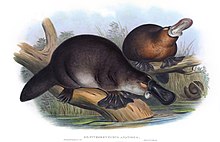
 A colour print of platypuses from 1863


 Platypus Skeleton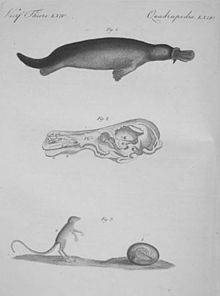




 Platypus Skeleton


